Honeywell TurboForce Air Circulator, Small Tabletop Fan, Quiet Personal Fan for Home or Office, 3 Speeds, 90 Degree Pivoting Head, Black, HT900 Review (2026)
Updated September 20, 2026 · Research-based review
Our verdict
The Honeywell TurboForce HT900 is a small tabletop air circulator with 3 speeds and a 90 degree pivoting head, built around a turbo blade design to move a lot of air for its size. It is a straightforward, no-frills fan for a desk or nightstand, though it lacks oscillation, a remote, or a timer, and runs louder than quiet DC-motor fans.
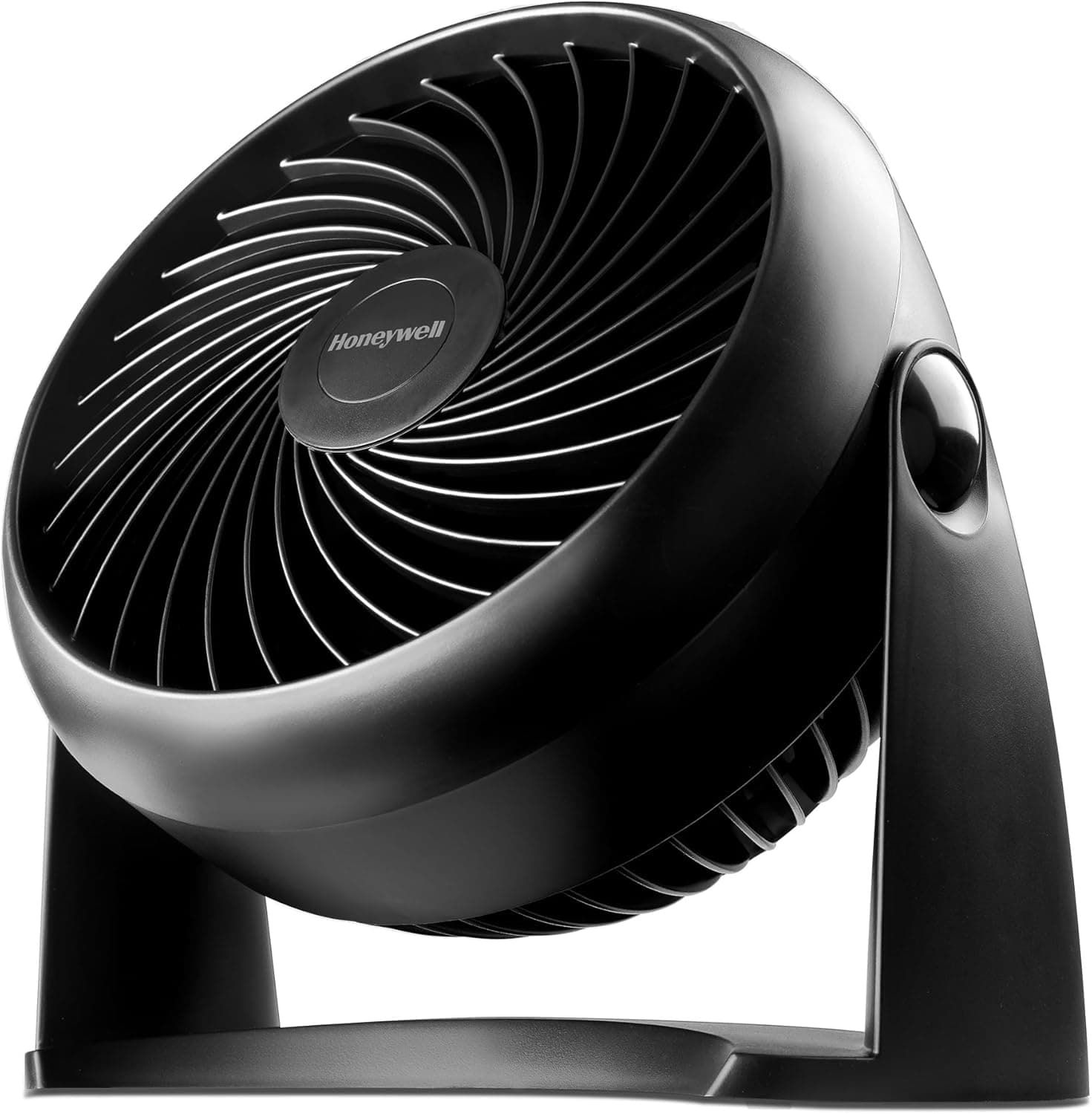
Honeywell TurboForce HT900 air circulator, a small black tabletop fan with 3 speeds and 90 degree pivoting head.
Price range: See on Amazon
What we liked
- + TurboForce blades move a surprising amount of air for the size
- + 90 degree pivoting head aims air up or down
- + Honeywell's long-selling model is cheap and durable
Trade-offs
- - Louder than DC fans at higher speeds
- - No oscillation, remote or timer
Size and airflow
The HT900 is a compact tabletop unit measuring roughly 8.94 inches wide by 6.3 inches deep by 10.9 inches tall, small enough to sit on a desk, nightstand, or narrow shelf without taking up much space. Despite the small footprint, Honeywell's TurboForce blade design is built to move a meaningful volume of air, with the fan rated for airflow that reaches noticeably further than its size would suggest, which is the main selling point of this line over similarly sized basic desk fans. That combination of a small physical size with above-average air movement is what has kept this model popular as a low-cost personal cooling option for years.
Controls and speeds
The fan offers 3 speed settings, a straightforward range from a gentler airflow setting up to a strongest setting for more direct cooling, controlled through a simple manual switch on the unit itself rather than a digital panel. It does not include oscillation, so the fan blows in a fixed horizontal direction unless you physically turn the whole unit, and it has no remote control or built-in timer, both of which are common on pricier desk and tower fans. For buyers who just want direct, adjustable airflow without extra electronic features to manage, this simpler control setup is easy to use, but it is a real limitation for anyone who specifically wants to set a fan to run for a fixed time overnight or wants oscillation to spread air across a wider area.
Pivoting head
The fan's head pivots up to 90 degrees, letting you aim airflow either straight ahead, angled upward toward your face while seated, or angled downward toward the floor or a lower area of a room. This vertical pivot is a useful substitute for the side-to-side oscillation the fan lacks, since it lets you redirect the airflow's target height even though the fan does not sweep left and right on its own. For a desk or nightstand fan aimed at one person rather than a whole room, this kind of directed, adjustable airflow is often more useful than oscillation anyway, since it lets you point the strongest air exactly where you are sitting or lying.
Noise
Because this fan relies on a conventional AC motor and blade design rather than a quieter brushless DC motor, it runs noticeably louder at its higher speeds than newer DC-motor desk fans marketed specifically around quiet operation. At the lowest of its 3 speeds the noise is more tolerable for something like a nightstand or bedside placement, but running it on the highest setting produces a clearly audible motor and airflow sound that some light sleepers may find disruptive overnight. Buyers prioritizing near-silent bedroom operation above all else may want to compare this against dedicated quiet bedroom fans, while those who mainly want strong, direct airflow and do not mind some fan noise will find this less of a drawback.
Value and durability
The HT900 has been one of Honeywell's longest-running personal fan models, and its continued availability across major retailers reflects a track record of being a reliable, inexpensive option in the small tabletop fan category. It skips extras like remotes, timers, and oscillation in favor of a simple, durable design focused on airflow and a compact footprint, which keeps the price low relative to feature-heavier competitors. For anyone who wants a dependable, no-frills personal fan for a desk, nightstand, or small space and does not need smart features, this is a reasonable, budget-friendly choice, though those extras are worth seeking out elsewhere if oscillation, a timer, or quieter DC operation matter more to you.
Frequently asked questions
Does the Honeywell HT900 oscillate?
No, it does not oscillate side to side. The head pivots up to 90 degrees vertically instead.
How many speed settings does it have?
It has 3 speed settings, controlled by a manual switch on the unit.
Does it come with a remote or timer?
No, the HT900 has no remote control and no built-in timer.
Is this fan quiet enough for a bedroom?
It is quieter on its lowest speed, but at the highest setting the conventional motor produces noticeably more noise than DC-motor fans marketed for silent operation.
Prices change often, so check the current price and availability on Amazon.
Check price on AmazonCool Sleep Picks may earn a commission from the link above.